“Criteria for Finding a Good Facelift Clinic in Seomyeon, Busan”

Have you ever washed your face in the morning and suddenly found yourself comparing an old photo side by side with your face today? Your eyes and mouth look the same, but noticing that your cheeks have started to sag and your jawline has lost its definition can leave you with a complicated feeling. This kind of change is a completely natural part of aging — the collagen and fat layers that once supported your skin’s elasticity gradually diminish, and the ligaments and fascia that held your face up begin to sag downward. The real problem is that at some point, this change reaches a stage where makeup or home care can no longer hide it. Especially if the face in a photo is smiling, but the expression staring back in the mirror looks heavy and tired, that’s not just a trick of your mood — it can be a real sign that your facial structure has shifted. That’s usually when people start searching for a facelift in Busan.
A facelift isn’t simply a procedure that pulls and removes excess skin — it repositions the sagging SMAS fascia layer back into place, correcting the actual structure of the face. Non-surgical options like thread lifts or radiofrequency treatments can offer some improvement, but once the fascia layer itself has sagged, simply tightening the surface of the skin has clear limits. Over time, the sagging often reappears quickly, or all that’s left is an unnatural pulled look. That’s why, if your sagging is significant, or if you’ve already tried several non-surgical treatments without a satisfying result, considering a facelift that addresses the underlying structure can be the more realistic choice.
Not all facelifts are performed the same way. For pronounced sagging in the cheeks and jawline, a traditional facelift with a wider incision may be considered, while for relatively mild sagging, a mini facelift with a smaller incision might be more appropriate. Many patients also choose to combine a neck lift if they want to address neck wrinkles and a double chin at the same time. More recently, techniques have branched out further depending on how deep into the fascia layer the surgeon works and the specific approach used — and these differences ultimately come down to each patient’s skin thickness, fat volume, and areas of sagging, so the right approach for you can really only be determined through an in-person consultation. That’s exactly why it matters to find a clinic that carefully maps out your specific areas of sagging during the consultation and explains, with concrete reasoning, which technique suits your case.
In fact, the question people considering a facelift in Busan ask most often is, “Is now the right time for me to get this done?” Having it too early can actually make the result look less natural, while waiting too long can mean more severe sagging, a longer recovery, and the need for more complex procedures. The real answer has less to do with age itself and more to do with your skin’s elasticity, the degree of sagging, and how much the change bothers you in daily life. If there’s a particular area that catches your attention every time you look in the mirror, it’s worth starting there and bringing it up specifically during your consultation.

There’s also a simple way to get a sense of timing on your own. If gently lifting your cheek with your fingertips instantly makes you look noticeably younger, that’s a sign the sagging is more likely coming from the fascia layer rather than the skin itself. On the other hand, if lifting doesn’t make much visible difference, you may still be at a stage where non-surgical maintenance is enough. Of course, this kind of self-check is only a rough guide — an accurate assessment requires an actual physical exam to determine exactly which layer has sagged and how much. That’s why how carefully a doctor maps this out early in the consultation is one useful way to judge a clinic.
Don’t forget to check the surgeon’s qualifications and area of focus. Being a board-certified plastic surgeon is the baseline, but what matters more is whether they have a consistent track record specifically in lifting and facial-contouring procedures. Even among certified surgeons, someone who has built their career mainly around eye or nose surgery will have developed different expertise than someone who focuses on structural procedures like facelifts. Don’t feel awkward about asking directly about their academic activities or case history with this specific procedure during the consultation — a clinic that answers this kind of question thoroughly is usually one that has the track record to back it up.
Safety matters just as much as the outcome when it comes to a facelift. The face is dense with sensitive structures like the facial nerve, blood vessels, and the parotid gland, so it takes a surgeon with a precise understanding of facial anatomy to minimize the risk of nerve damage and other complications. You can get a good sense of a clinic’s expertise by how specifically the doctor identifies your particular pattern of sagging during the consultation, and how clearly they explain the expected incision lines and scar-management plan. A clinic that goes into detail about exactly which fascia layer will be addressed and how — rather than offering a vague “you’ll look great” — is one you can trust for a facelift in Busan.
Reviewing before-and-after photos is also worth doing carefully. A clinic that can show a wide range of cases — front and side angles, varying degrees of sagging — rather than just one or two flattering shots, reflects a deeper base of experience. It’s especially useful to ask whether they have cases similar to your own age group or type of sagging, since that gives you a much more concrete sense of what kind of change to expect for yourself. Photos alone can’t tell you everything, but how transparently a clinic shares this kind of material is a useful reference point for judging its credibility.
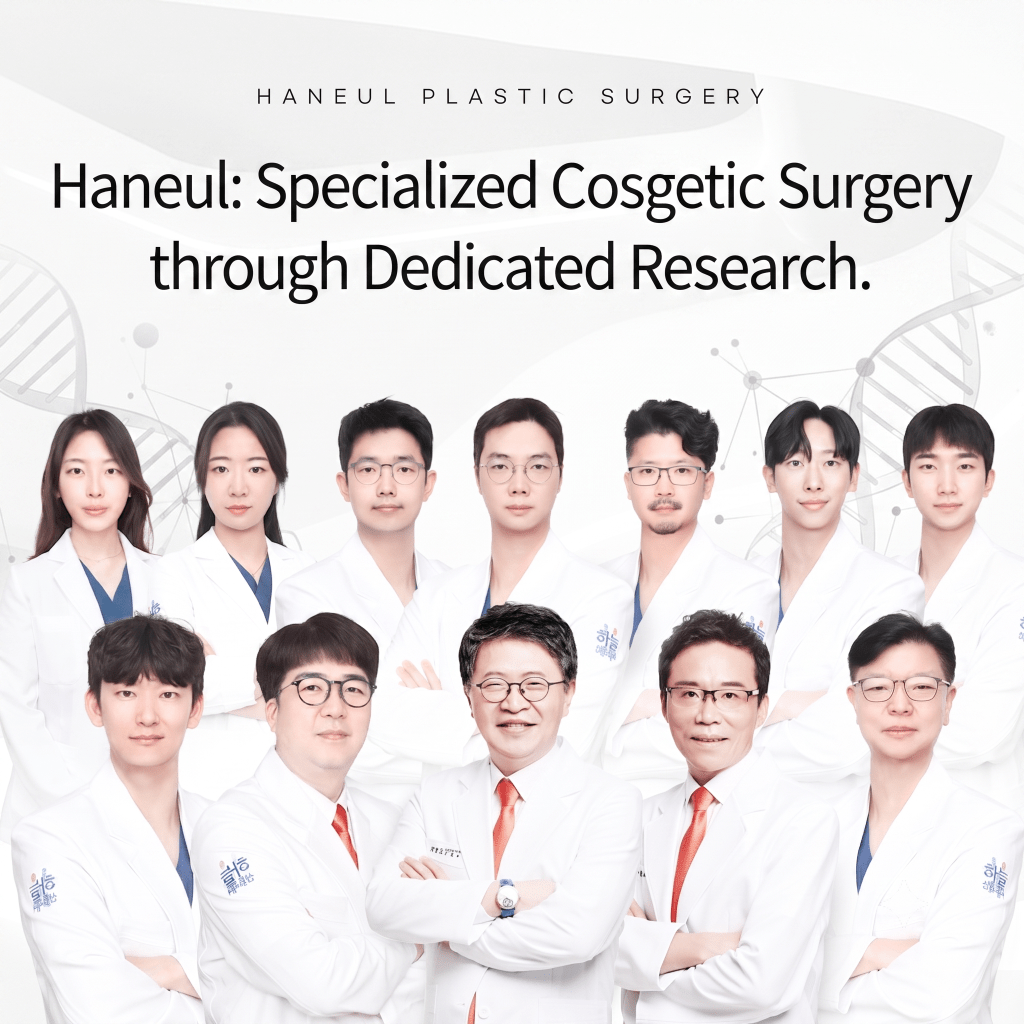
Anesthesia is another aspect you can’t afford to overlook. Facelifts tend to take longer than many other procedures, so it’s especially important to check whether an anesthesiologist is present throughout the surgery, continuously monitoring vital signs like blood pressure and oxygen saturation. Don’t hesitate to ask during your consultation whether the clinic has the equipment and staff to respond immediately in an emergency. If a clinic can’t answer this kind of question clearly, or gives you a vague response, it’s worth reconsidering — no matter how good the expected results might look.
Experience with revision surgery and complex cases is another factor worth paying attention to. It’s fairly common for a face to have some asymmetry or a history of previous procedures, so a surgeon who has handled a wide range of variables tends to adapt more flexibly to unexpected situations than one who has only worked on straightforward cases. It’s also common to combine a facelift with other procedures like eyelid surgery, rhinoplasty, or fat grafting, and in these cases, judgment on how to prioritize and sequence each area really comes down to the surgeon’s experience. For example, if you’re considering a facelift together with eyelid surgery, the two areas heal from swelling at different rates, so how well the timing and spacing between them is coordinated can affect how natural the overall result looks.
Setting realistic expectations is also a major factor in how satisfied you’ll be with the result. A facelift improves sagging and redefines your facial contours, but it isn’t a procedure that resolves everything down to fine lines, pores, or pigmentation on the skin itself. That’s why remaining texture-related skin concerns are often managed separately with non-surgical treatments like Rejuran, skin boosters, or laser care, even after the sagging itself has been corrected. A clinic that clearly distinguishes “this is addressed by surgery” from “this needs separate ongoing care” — rather than letting you assume surgery will fix everything — is one you can trust not to oversell the result.
If you get consultations at a few different clinics, you’ll quickly notice how differently each one explains things. Some walk you through the structural cause of your sagging and the reasoning behind their recommended approach, while others lead straight with a price list. When comparing clinics, it’s worth focusing less on price and more on why each one is proposing the approach it is. The same sagging pattern can be interpreted differently from clinic to clinic, and comparing how well each explanation actually matches your own facial condition often makes it clear which surgeon has assessed you most accurately.

If you’re traveling from abroad, relying on recommendations from friends in Korea or Korean-language reviews simply isn’t realistic to begin with. In that situation, it matters far more to look at how systematically a clinic has handled international patients. It’s worth checking whether consultation materials and post-op instructions are available in English, whether there’s a dedicated coordinator or interpreter on staff, and whether you can have a video consultation before you travel to get an early look at your case and a rough surgical plan and timeline. A clinic with these systems well in place will help you avoid the frustration of communication gaps once you actually arrive.
Post-operative care is just as important in completing the final result. Some degree of swelling and bruising right after a facelift is completely normal, and how that period is managed can make a real difference in both recovery speed and how natural the final outcome looks. What matters most is whether the clinic has a structured program for lymphatic massage to reduce swelling and laser treatments to support healing, and above all, whether there’s a one-on-one system where your own surgeon personally checks your progress. A clinic where you can quickly get answers about wound healing, when stitches come out, or how sensation gradually returns will make the uncertainty of recovery much easier to manage.
It helps to have a rough sense of the recovery timeline. Swelling and bruising are usually most noticeable for the first three to four days after surgery. Between one and two weeks, stitches typically come out and swelling starts to visibly go down. By two to four weeks, most people can go about daily life without anything looking out of place, and over the following three to six months, the remaining subtle swelling gradually resolves as the final contour settles in. Of course, this pace varies depending on individual skin condition and the extent of the procedure, so it’s worth getting a specific timeline for your own case directly from the clinic during your consultation. If you’re traveling from abroad, it’s a good idea to use this timeline to discuss with the clinic exactly when it’s safe to fly, and what progress checks you should complete before heading home, so you can plan your travel dates accordingly.
There are also everyday things worth being mindful of in the early recovery period. Sleeping with your head slightly elevated for the first few days can help reduce facial swelling, and it’s best to hold off on intense exercise or anything like a sauna that raises your body temperature sharply until the swelling has settled down somewhat. Limiting sun exposure until scars have fully set is also the safer choice. A clinic that walks you through these kinds of everyday details in advance is one that lets you focus on recovery without unnecessary worry.
Mental preparation matters just as much as the surgery itself. In the early days of recovery, before the swelling has gone down, there can be a stretch where looking in the mirror feels more discouraging than reassuring — and knowing ahead of time that this is a normal part of the recovery process, not the final result, can make it much easier to get through emotionally. It helps to avoid packing your schedule too tightly early in recovery, and if you have a companion or caregiver with you, it’s worth letting them know in advance so they can keep an eye on how you’re doing. If you’re traveling alone, staying in touch with family back home over video calls can also help you stay grounded. Whether a clinic addresses this psychological side of recovery in advance is one way to tell whether it’s a place that only performs the surgery, or one that stays with you through the recovery process too.
Preparing your own list of questions before a consultation is a good way to make the most of your time there. Working out specific questions in advance — where the incision lines will likely be, roughly how long swelling and bruising will last, when stitches come out, how to reach the clinic if you notice numbness or anything unusual — helps you use your consultation time far more efficiently. The more specific and concrete a clinic’s answers are, rather than vague, the more likely it is that they’ve handled a wide range of cases and organized their process well. If you’re visiting from abroad, it’s worth asking in advance whether there’s staff who can communicate comfortably in English, whether you can get post-op care instructions in English too, and whether you’ll be able to check in on your progress by video call or message after you’ve returned home.
When comparing quotes across clinics, the differences can sometimes feel surprisingly large. Most of that gap comes down to the extent of the incision, the technique used on the fascia layer, the length of anesthesia, and whether any additional procedures are bundled in. Rather than simply choosing the cheaper number, it makes far more sense to compare what technique and level of care are actually included at that price. On the flip side, a higher price doesn’t automatically mean a better result — what matters most, in the end, isn’t the price itself but how accurately a clinic diagnoses your specific pattern of sagging and how well its proposed plan matches it.
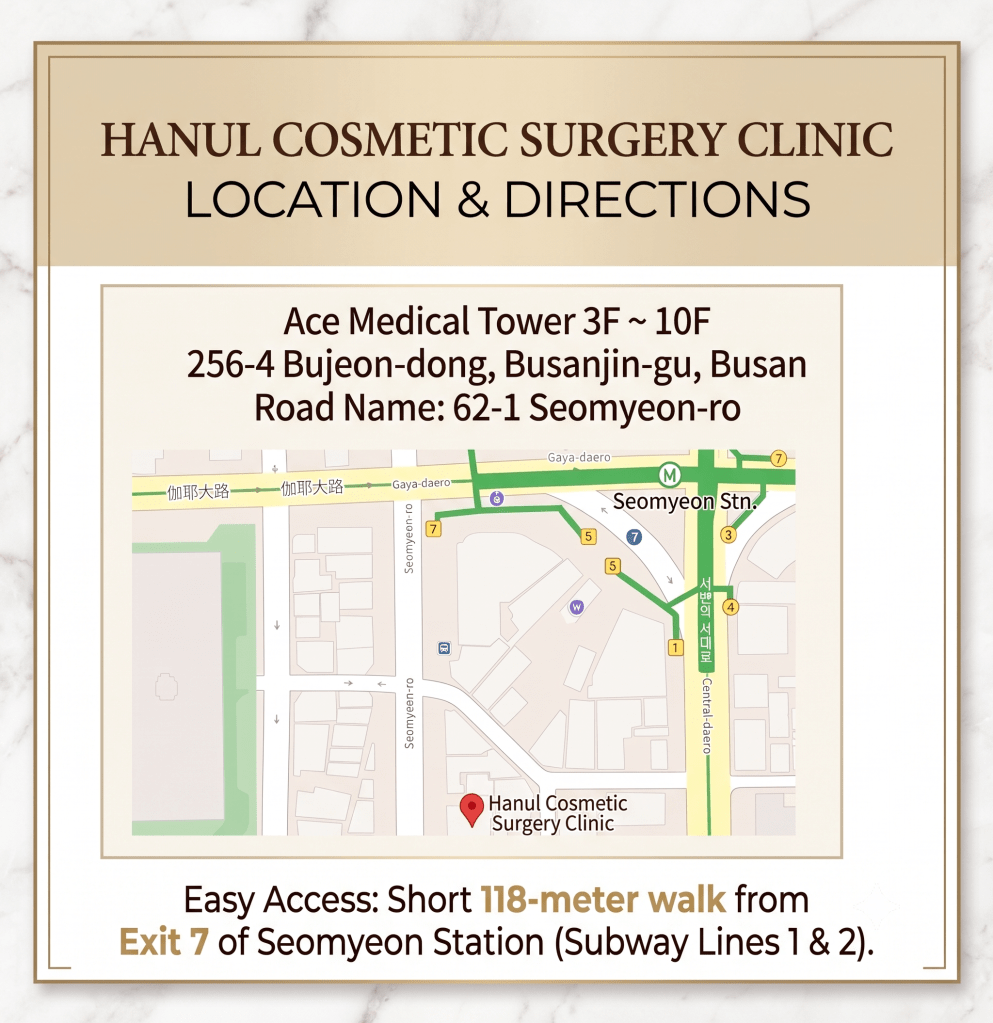
Seomyeon, in particular, is easy to reach from Gimhae International Airport and is well served by subway lines and nearby accommodation, making it a convenient area for international patients moving between their hotel and the clinic. It’s worth checking how flexibly a clinic can coordinate your consultation, surgery, and early follow-up visits around your flight schedule, and whether they clearly guide you on when it’s safe to board your return flight. A clinic located in Seomyeon, like Haneul Plastic Surgery Clinic, that can flexibly work around an international patient’s itinerary can take a lot of the travel-related stress off your plate.
Don’t overlook the basics either, like sterilization protocols and the condition of the operating room. A polished interior doesn’t automatically guarantee a safe surgical environment. In fact, the details that are less visible during a consultation — how thoroughly surgical instruments are sterilized, or how carefully a clinic checks a patient’s condition before surgery through a proper checklist — are what’s actually tied to real safety. These are things you’re unlikely to learn unless you ask directly, so don’t hesitate to bring them up.
Having a long-term care plan after surgery can help you hold onto your results for much longer. Even after a facelift has fundamentally corrected sagging, the natural aging process continues, so checking in every six months to a year and pairing that with light touch-ups or skincare treatments as needed can help the original result stay natural for longer. A clinic with a system for regular follow-up visits after surgery is a more reassuring long-term choice, since you’ll be able to comfortably return for a consultation even years down the line.

In the end, a facelift is surgery on the face — the single most sensitive and important part of anyone’s appearance. Because a single decision here has a lasting impact, it’s worth resisting the urge to rush and instead comparing enough information to find a surgeon who can accurately assess your specific condition. If you’re considering a facelift in Seomyeon, Busan, look beyond price and marketing language to how clearly a clinic’s team explains things, how solid their safety systems are, and how well they follow up with you afterward, and choose the place that’s the right fit for you. A consultation at Haneul Plastic Surgery Clinic can be a good first step toward making that decision.
 하늘성형외과의원
댓글 남기기