“First Time Getting Radiesse in Busan? How Much Looks Natural”
If you spend enough time researching skin boosters, at some point you’re bound to run into the name Radiesse. It seems to be telling a different story from hyaluronic acid skin boosters, and a lot of people aren’t quite sure what the actual difference is. Radiesse holds its own distinct place among names like Rejuran, Retuo, and Gouri, and once you really understand what that place is, it makes sense why more and more people keep searching for Radiesse in Busan. For anyone who wants more than just hydration or a bit of elasticity someone who wants a collagen stimulator that builds volume at the same time Radiesse is a solid option.
To understand Radiesse, you first need to know about an ingredient called CaHA. CaHA stands for calcium hydroxylapatite, a mineral that occurs naturally in our bones and teeth. When this ingredient is used in fillers or skin boosters, it works in two stages. Right after injection, the gel-based material creates immediate volume, and over time, the CaHA particles act as a scaffold that stimulates collagen production. As new collagen forms, the structure beneath the skin gradually becomes firmer. Being able to expect both an immediate volumizing effect and long-term collagen regeneration at the same time is Radiesse’s biggest defining feature.
The difference becomes clearer when you compare Radiesse with hyaluronic acid fillers or skin boosters. Hyaluronic acid works by drawing in water to create volume, so the change is immediately visible, and it has the advantage of being dissolvable with an enzyme if needed. Radiesse, on the other hand, is also naturally broken down by the body, but since there’s no dissolving enzyme for it, once it’s injected it simply absorbs gradually over time. It lasts considerably longer than hyaluronic acid, and because it works by generating new collagen rather than just filling volume, you can expect the quality of your skin itself to keep improving as time goes on. This is exactly why Radiesse in Busan feels like it belongs in a different category from a simple volumizing filler or hydrating skin booster.
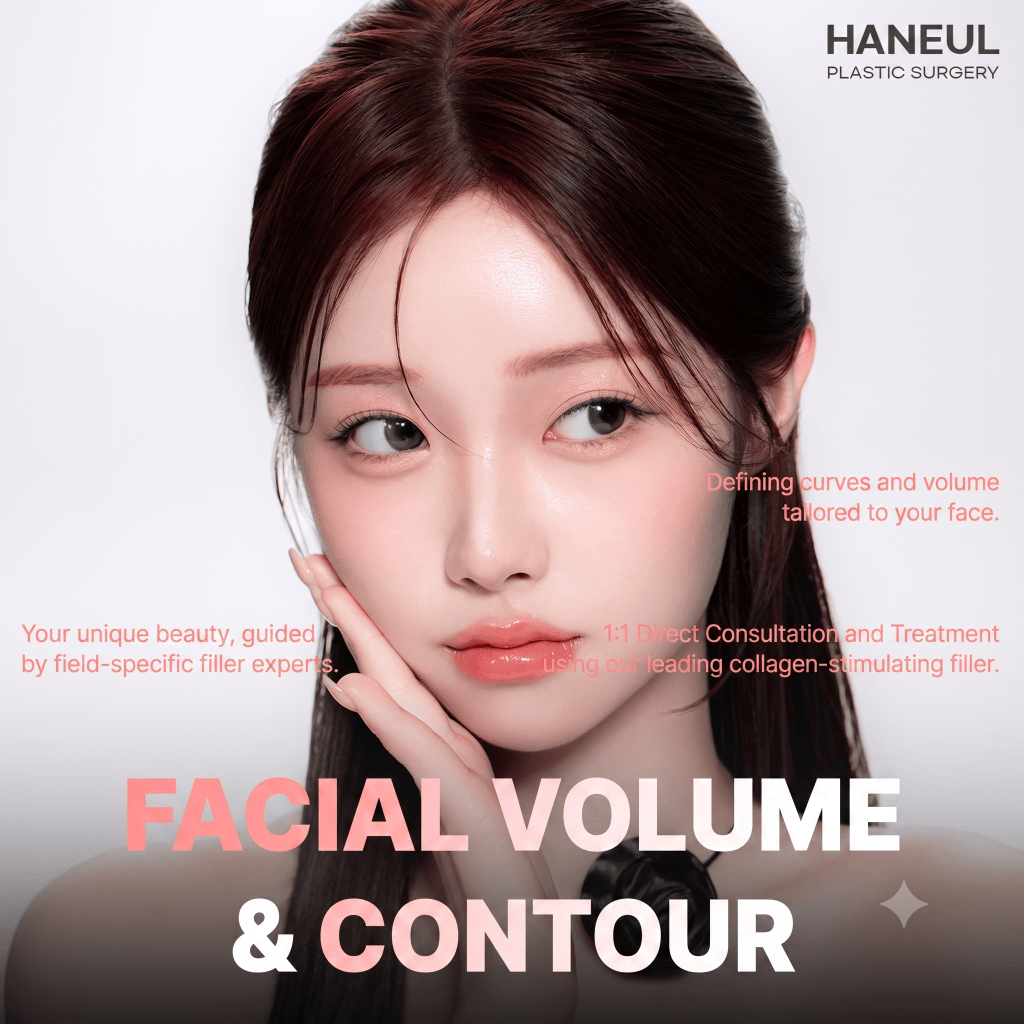
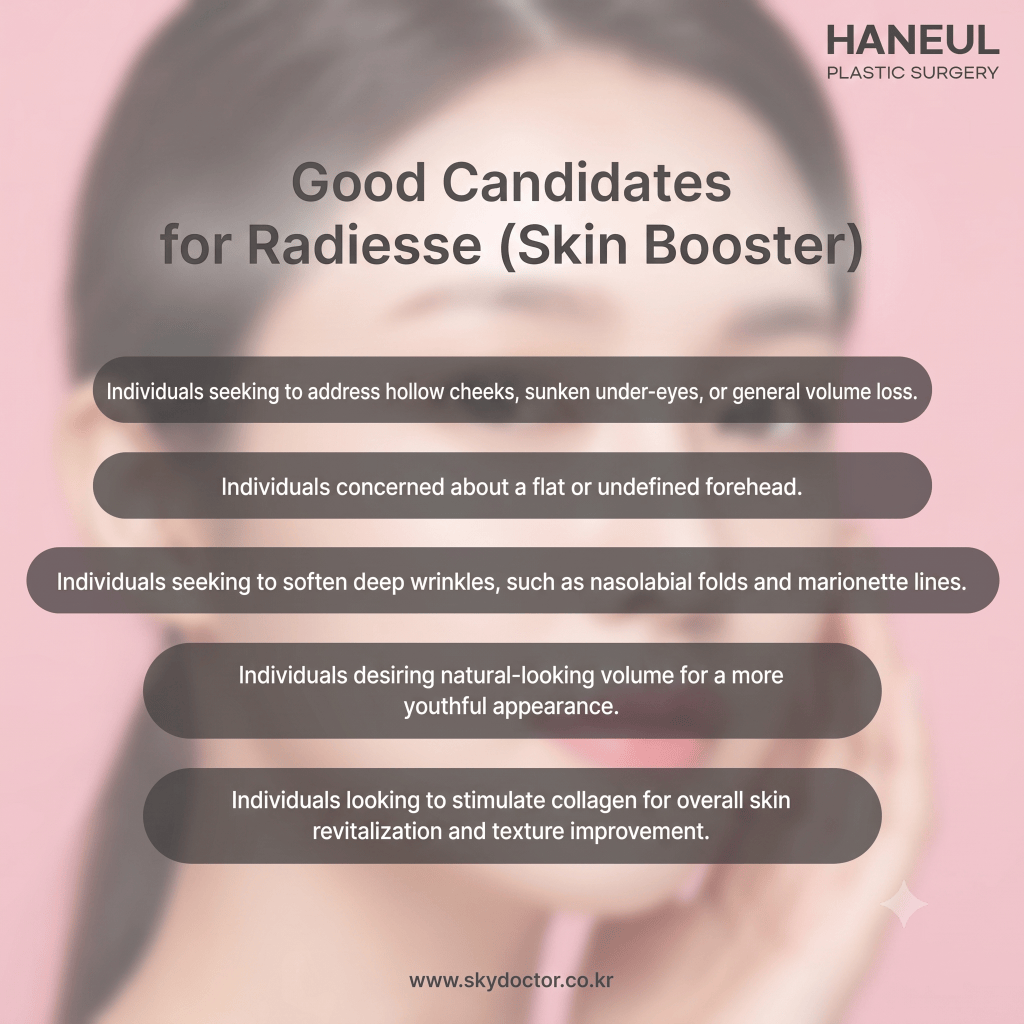
Looking at the cases where Radiesse works especially well helps clarify who it’s actually suited for. It can be effective for people who have lost overall facial volume and are starting to notice sagging, people whose nasolabial folds or marionette lines have deepened and made the lower face look heavier, and people bothered by noticeable volume loss in areas like the cheeks or under-eye hollows. It can also be a good approach for people whose skin has thinned and lost firmness, since Radiesse works by rebuilding structural support beneath the skin. For anyone who wants to restore the skin’s own underlying support rather than simply fill in wrinkles, Radiesse in Busan can be a meaningful option.
The areas where Radiesse can be used are more varied than you might expect. The cheeks and nasolabial folds are the most commonly treated areas, typically used to naturally fill in hollow cheeks and soften the depth of the nasolabial folds. It’s also used for under-eye hollows or shadow-based dark circles, and to add volume along the jawline to refine its contour. It’s sometimes used on areas outside the face too, such as the backs of the hands, where it can be an option for improving skin affected by aging. That said, it’s often not well suited for areas with a lot of movement, like the lips, so it’s important to confirm exactly which area is appropriate during your consultation.
There are also a few things worth knowing before getting Radiesse in Busan. Since a gel-based material is injected, you should avoid massaging or applying strong pressure to the treated area for a few days after the procedure. Some swelling or bruising can occur early on, but it usually settles within a few days to about a week. It’s best to avoid saunas or intense exercise right after treatment, and to be careful not to expose the treated area to strong stimulation while it’s settling. Since the collagen-building effect appears gradually over time, it’s more realistic to expect the real change to show up between one and three months later, rather than looking for an immediate transformation.
How long the effect lasts is one of the key reasons people choose Radiesse. Compared to hyaluronic acid fillers, which typically last six months to a year, Radiesse tends to last considerably longer. The effect commonly lasts around a year to a year and a half, and depending on individual skin condition and lifestyle, it can last even longer than that. That’s because collagen regeneration continues throughout the gradual breakdown of the CaHA particles, and even after the material itself has been absorbed, the newly formed collagen structure continues to support the skin. This is a big part of why many people who choose Radiesse in Busan are looking to reduce the burden of repeated touch-up treatments.
There are also treatments that can work well alongside Radiesse. Pairing it with lifting procedures like Ulthera Prime or thread lifting means you’re lifting sagging skin while also adding volume and collagen regeneration through Radiesse. It’s sometimes combined with hyaluronic acid skin boosters as well, with Radiesse building structural support and hyaluronic acid adding hydration — each playing a different role. Since Gouri, a PCL-based collagen stimulator, uses a different active ingredient, it’s more often chosen as an alternative depending on skin condition rather than used alongside Radiesse. Which combination actually fits your skin is something to work out in a proper discussion of your current skin condition and goals during a consultation.
One thing people often ask about with Radiesse is the risk of side effects like nodules or lumping. There have been rare reports of the CaHA particles clumping in a specific area and becoming palpable as a nodule. The likelihood of this kind of side effect tends to vary a lot depending on the injector’s experience and technique. Maintaining the right dilution ratio, injection technique, and precise injection depth matters a great deal, and gently massaging the area right after treatment to help the material settle evenly also helps reduce the risk. This is exactly why, when choosing a clinic for Radiesse in Busan, it’s especially important to confirm that the provider has substantial hands-on experience with the treatment.
There are also a few things worth confirming during your consultation when planning Radiesse in Busan. It’s worth thoroughly discussing what dilution ratio will be used, which areas will be injected and how, and whether your current volume loss and desired outcome are realistically aligned. If it’s your first time getting Radiesse, it’s safer to start with a smaller amount, check the result, and then decide whether to add more. Taking a gradual, staged approach rather than injecting a large amount all at once tends to lead to a more natural look and higher satisfaction.
Q. How is Radiesse different from a hyaluronic acid filler?
A. Hyaluronic acid fillers work by drawing in water to create immediate volume, and they can be dissolved with an enzyme if needed. Radiesse works through CaHA, which creates immediate volume while also encouraging collagen regeneration. It lasts longer and works toward improving the skin’s actual structure, which is what sets it apart. That said, since there’s no dissolving enzyme for it, once it’s injected you simply have to wait for it to break down naturally.
Q. When do you start to notice the effects of Radiesse?
A. The immediate volumizing effect from the gel material appears right after injection. The improvement in skin elasticity from collagen regeneration tends to become noticeable gradually, starting around one to three months later. As time passes, the skin’s overall quality continues to improve.
Q. How long does Radiesse last?
A. It varies by individual skin condition and lifestyle, but it commonly lasts around a year to a year and a half. Collagen regeneration continues while the CaHA gradually breaks down, and even after it’s absorbed, the newly formed collagen structure continues supporting the skin — which is why the effect lasts relatively long.
Q. Can nodules form after getting Radiesse?
A. There have been rare reports of CaHA particles clumping in a specific area and becoming palpable as a nodule. Being treated by an experienced provider who maintains the right dilution ratio, injection technique, and precise injection depth can significantly reduce the likelihood of this happening. It’s important to confirm that the provider has substantial hands-on experience with the treatment.
Q. Should I choose Radiesse or Gouri?
A. The two products differ in ingredients and how they work. Radiesse is CaHA-based and offers both immediate volume and collagen regeneration at the same time, while Gouri is a liquid PCL-based product that spreads evenly through the skin and stimulates collagen production more broadly. If volume improvement is your main goal, Radiesse may be the better fit; if overall skin elasticity is your main goal, Gouri may suit you better. It’s best to decide together with your provider based on your specific skin condition during a consultation.
 하늘성형외과의원
댓글 남기기