“How Should You Prepare for an Eye Surgery Design Consultation?”
↑ Learn more about eye plastic surgery
The moment someone starts seriously thinking about eye surgery is different for everyone. Some people have been bothered by not having a double eyelid crease for years. Others get a jolt from a photo where their eyes look far smaller than they feel they are. Still others start noticing, as they get older, that their eyelids feel progressively heavier. Among international visitors researching plastic surgery clinics in Seomyeon, Busan while planning a trip to Korea, more and more are asking specifically about eye surgery. Korea has built a strong global reputation in eye surgery, and Korean surgeons are internationally recognized for procedures that require especially precise design, like double eyelid surgery and ptosis correction. If you have a trip to Busan, Korea on your calendar, seriously considering eye surgery can be a genuinely worthwhile choice.
Eyes carry far more weight in how a face reads than most people realize. When you first meet someone, their eyes are usually the first thing you look at, and a lot of a person’s emotion and energy comes through the eyes alone, without a word being said. That’s why eye surgery is often about more than just wanting to look prettier — it frequently comes from a deeper wish to express yourself the way you actually want to come across. Changing just the shape of your eyes can change the whole impression your face gives, and many people find that shift carries over into everyday confidence.
There’s a surprising range of eye procedures out there. Double eyelid surgery, ptosis (eye-opening) correction, inner-corner surgery, outer-corner surgery, upper blepharoplasty, under-eye fat repositioning, brow lift — the range of procedures built around a single feature is much wider than people expect. One of the most common mistakes people make when they first start looking into eye surgery is assuming that “eye surgery” automatically means double eyelid surgery. What you actually need can be completely different depending on whether you want a crease, want your eyes to open wider, or want them to look longer horizontally. Working out what change you actually want before your trip to Korea makes your in-person consultation far more specific once you arrive.
Let’s start with double eyelid surgery. This is the procedure people choose when they don’t have a crease, or only have a partial one, and want a clearly defined line. There are two main methods: non-incisional and incisional. The non-incisional method uses sutures to create the crease without cutting, so recovery is faster and swelling is lighter. The incisional method involves cutting into the eyelid to adjust the fat and skin directly, which produces a longer-lasting, more defined crease, but takes longer to recover from. If your trip to Korea is short, the non-incisional method may put less pressure on your schedule, but depending on your eyelid condition, the incisional method may actually be the better fit — so it’s important to get a proper evaluation during your consultation.
↑ Learn more about eye plastic surgery
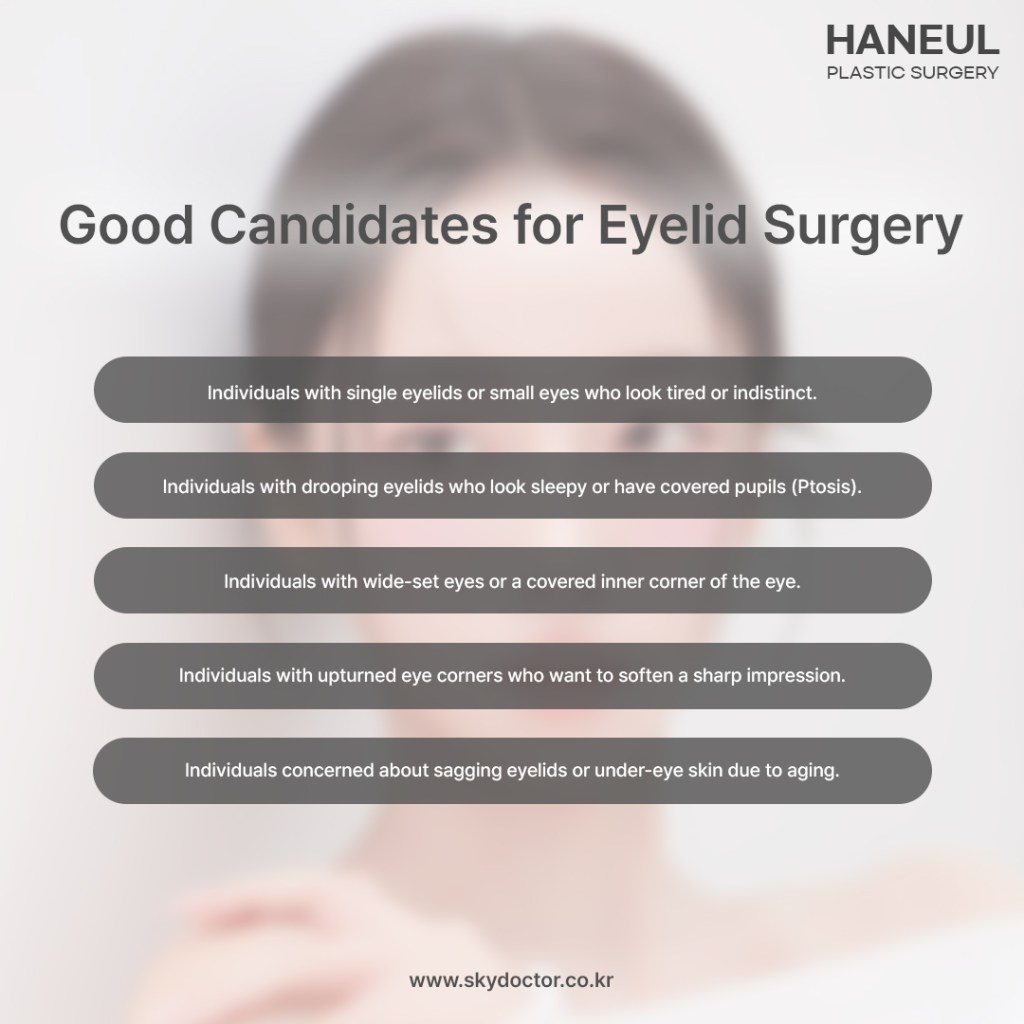
Ptosis correction is treated with just as much importance as double eyelid surgery in eye surgery consultations. It corrects ptosis, a condition where the levator muscle that opens the eye isn’t strong enough, so the eye doesn’t open fully — and a surprising number of people have ptosis without realizing it. If more than half of your iris is covered when you open your eyes as wide as you can, if you catch yourself using your forehead muscles to help open your eyes, or if your eyes feel heavier or droopier later in the day, ptosis is worth considering. Ptosis correction isn’t just about making the eyes look bigger — it has a functional side, correcting the eye’s actual ability to open properly, which is why patients sometimes notice their forehead wrinkles naturally soften as an added effect.
Corner surgery changes the horizontal length and shape of the eye. Inner-corner surgery (epicanthoplasty) releases the epicanthal fold at the inner corner of the eye to make the eyes look wider and more defined. Outer-corner surgery (canthoplasty) opens up the outer corner to extend the horizontal length of the eye. These corner procedures are sometimes done on their own, and often combined with double eyelid surgery or ptosis correction. Which type of corner surgery is right for you comes down to evaluating your eye shape together with the look you’re going for.

Age-related changes to the eyes are another major area covered in eye surgery consultations. This spans a wide range of concerns across different ages: upper blepharoplasty for loose, sagging skin above the eye, brow sagging that makes the eyes look smaller as the brow drops, and under-eye fat that pushes forward and creates a tired look. People who come in for eye surgery after their 40s are often less interested in creating a crease and more focused on an overall refresh for eyes that have started to look heavy and droopy. In these cases, combining procedures like upper blepharoplasty, a brow lift, and under-eye fat repositioning often leads to a more natural, harmonious result than any single procedure on its own.
Planning your eye surgery around your trip to Korea matters too, since the length of stay you’ll need depends on the procedure. Fast-recovery procedures like non-incisional double eyelid surgery can often work with a trip as short as three nights and four days. Procedures that need more recovery time, like the incisional method or ptosis correction, usually call for a stay of at least 7 to 10 days. It’s best to build your schedule around pre-op consultation and evaluation, plus an early recovery check and stitch removal after surgery. Busan is also fairly accessible, with direct flights to major cities across Asia through Gimhae International Airport.
↑ Learn more about eye plastic surgery
Many patients also want to know how follow-up works once they’re back home. The final result of eye surgery isn’t visible until the swelling has fully resolved, usually around three to six months later, so some form of follow-up after you return is necessary. These days, many clinics manage this through telemedicine, letting you share photos or video to check your progress. If you notice anything unusual or you’re concerned about how things are healing, you can simply reach out to your surgical team and share your condition remotely. If you happen to get the chance to visit Busan again, an in-person visit to confirm your final result is always the best option.
When choosing a clinic for eye surgery, it’s worth checking whether they have real experience working with international patients. Confirming things like whether consultations are available in your language, whether you can get the medical documents and records you’ll need before and after surgery, and whether a remote follow-up system is in place once you’re back home can all help you plan your surgery with more peace of mind. The basics to check are whether a board-certified plastic surgeon personally handles everything from consultation to surgery, and whether they have substantial experience across a wide range of eye surgery cases, including revisions. Since the results of eye surgery last a long time, gathering enough information and carefully choosing your clinic before your trip to Busan, Korea is the single most important part of your preparation.
Q. How long of a stay do I need for eye surgery during a trip to Busan, Korea? A. It depends on the procedure. Fast-recovery procedures like non-incisional double eyelid surgery can often work with a trip of around three nights and four days. Incisional methods or ptosis correction usually call for at least 7 to 10 days. It’s best to plan a schedule that includes your pre-op consultation and stitch removal after surgery.
Q. What does the schedule look like on the day of surgery?
A. Surgery day requires at least half a day, since it includes final checks and anesthesia preparation. Afterward, you’ll typically be monitored in a recovery room for a period of time before heading home the same day. It can be hard to get around on your own that day, so having someone with you is a good idea, and it’s worth asking the clinic in advance for a clear rundown of what to expect.
Q. How is my recovery followed up once I’m back home?
A. Many clinics manage this through telemedicine, letting you share photos or video to check your progress. If you notice anything unusual or you’re concerned about how things are healing, you can simply reach out to your surgical team and share your condition remotely. It’s worth confirming in advance whether the clinic has a proper remote aftercare system for international patients.
Q. Can I do an online consultation before surgery?
A. Yes, many clinics offer this. Sharing your concerns, what you’re hoping for, and any previous procedures along with photos online in advance can make your in-person consultation much more efficient once you arrive. Once you’re there, you’ll go through a detailed evaluation, meet the surgeon in person, and finalize your surgical plan.
Q. When can I fly home after surgery?
A. It varies by procedure, but most patients fly home after their stitches have been removed. Long flights can affect swelling, so it’s best to build in extra buffer when planning your return date. Exactly when it’s safe to fly is safest to determine based on your surgical team’s guidance.


답글 남기기