“Can I change my facial shape by visiting Busan, Korea for facial contouring?”
The moment your face shape starts bothering you usually comes from a photo. You look fine enough head-on, but in a group photo your face is the only one that looks noticeably bigger, or your cheekbones seem to stick out too much, or you change your hairstyle over and over but somehow your face shape always ends up working against you. Among international visitors researching plastic surgery clinics in Seomyeon, Busan while planning a trip to Korea, more and more are asking specifically about facial contouring surgery. Once people realize that makeup or a new hairstyle can’t really fix this at the root, they start looking into changing the bone structure itself, and that’s often what brings them to Korea. Korea has built a strong global reputation in facial contouring surgery, and Korean surgeons are internationally recognized especially for cases that combine correction of the jaw, cheekbones, and chin together.
The bone structure of your face has far more influence on your overall look than most people realize. Even with the exact same eyes, nose, and mouth, your entire impression can change completely depending on the shape of your facial skeleton. Cheekbones that flare out to the sides can make the face look flat and wide, a well-developed jaw angle can give the lower face a heavy, strong look, and a chin that’s short or set back can throw off the overall facial proportions. This is exactly why facial contouring surgery is described as something that changes your whole facial impression, not just a single feature. When the bone structure changes, the muscle and skin sitting on top of it shift along with it, which is what gives the eyes, nose, and mouth a more defined, three-dimensional look.
↑ Check detailed information on facial contouring
Jaw reduction surgery is one of the most commonly performed procedures in facial contouring. The right approach depends on whether the squared jaw comes from bone or muscle. If the jaw angle itself — the mandibular angle — is well developed, the bone needs to be reshaped, but if the issue is an overdeveloped masseter, the chewing muscle, Botox can offer some improvement on its own. When both factors are present together, surgery tends to give a much more definitive correction. Jaw reduction surgery is performed through an incision inside the mouth, so there’s no visible scarring on the outside, and once the lower face is slimmed down, the eyes and nose often naturally look more defined as a result.
Cheekbone reduction is another essential procedure in facial contouring. The surgical approach depends on whether the cheekbones protrude to the sides or forward. Cheekbones that flare outward are corrected by cutting the arch and repositioning it inward, while cheekbones that project forward are corrected by reshaping the cheekbone itself. When both directions are involved, a 3D cheekbone reduction is often used to address them together. Once the cheekbones are reduced, many patients find that their whole face looks noticeably more refined and softer, even with the same eyes and nose as before.
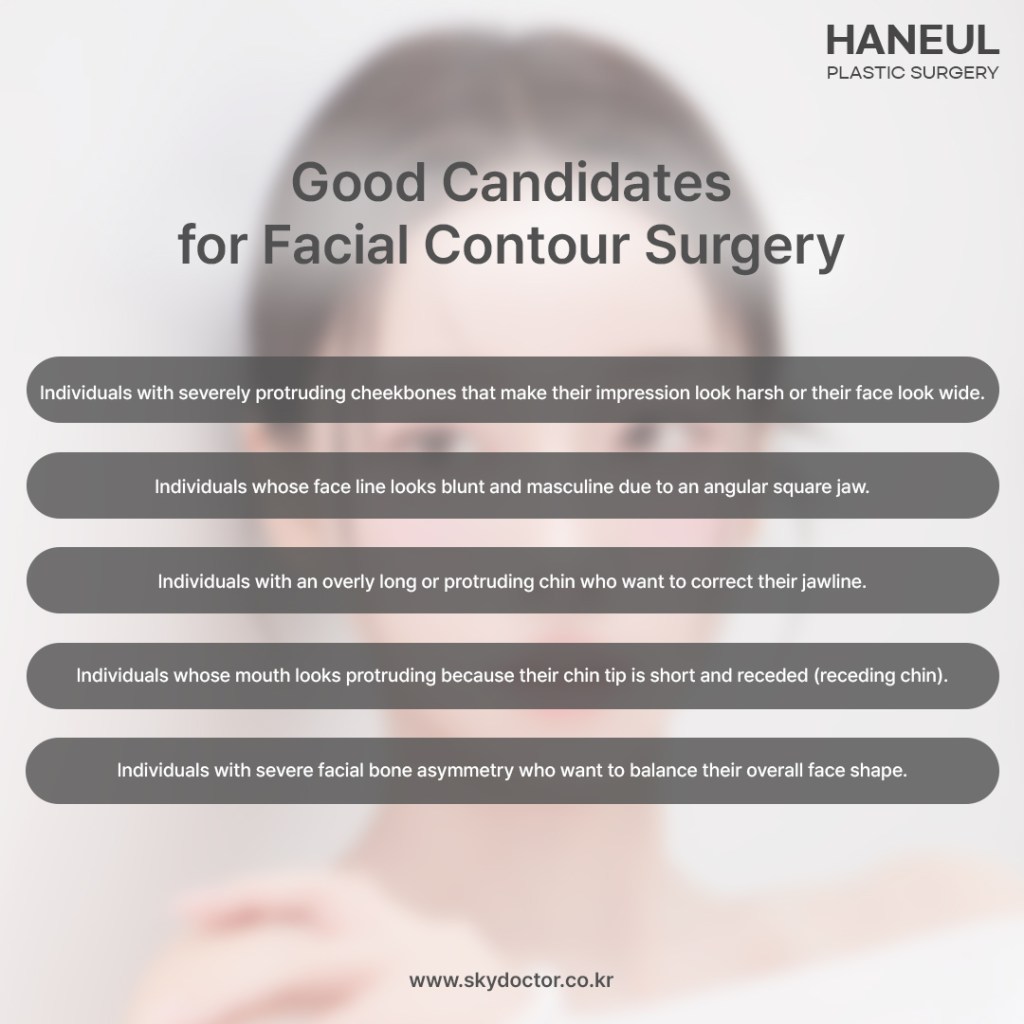
When correcting the jaw and cheekbones together, overall facial balance and proportion become especially important. Correcting only the jaw can make the cheekbones stand out even more by comparison, and reducing only the cheekbones can leave the jaw looking just as prominent as before, so the result may not fully achieve what you were hoping for. This is exactly why facial contouring isn’t planned by looking at each area separately — the surgery has to be designed around the overall proportion and balance of the whole face. Sharing photos of your face through an online consultation before your trip to Korea, and getting an early sense of which combination of procedures would suit you best, can make your in-person consultation once you arrive much more efficient.
Chin surgery is another important part of facial contouring. It’s a good option if your face looks fine from the front but your chin looks weak or set back in profile, or if your chin projects too far forward or looks too short, throwing off your overall proportions. There are two main approaches: adding volume with an implant, or directly cutting and repositioning the bone. The bone-based approach allows for precise adjustment in multiple directions, which tends to produce a more natural, stable result. Planning chin surgery together with the rest of your facial contouring can completely change not just your front-facing proportions but your profile as well.

↑ Check detailed information on facial contouring
It’s worth understanding why a 3D CT scan is essential before surgery. Since this surgery works directly with facial bone, accurately mapping bone thickness and shape, along with the exact location of the nerves and blood vessels running through it, is fundamental to a safe procedure. This matters especially for the inferior alveolar nerve running through the lower jawbone — if it’s damaged during surgery, it can cause numbness around the chin and lips — so precisely locating it beforehand and establishing a safe surgical margin is essential. When you visit Busan, Korea, a 3D CT scan and detailed evaluation are typically done in person before your surgical plan is finalized.
If you’re planning to visit Busan, Korea for facial contouring surgery, it’s important to plan your stay and surgical schedule together. Since this surgery involves working directly with bone, a stay of at least 10 to 14 days is often recommended, including pre-op exams and consultation, plus checking your early recovery afterward. It’s best to plan your flight home once you’ve recovered to a point where you can comfortably go about daily life. Busan is well connected, with direct flights to major cities across Asia through Gimhae International Airport, so travel logistics tend to be fairly convenient. Your surgical team is in the best position to tell you exactly when it’s safe to fly.
It’s worth understanding in advance how follow-up works once you’re back home. The final result of facial contouring surgery isn’t visible until six months to a year later, so ongoing follow-up after you return is necessary. These days, many clinics manage this through telemedicine, letting you share photos or video to check your progress. If you notice anything unusual or you’re concerned about how things are healing, you can simply reach out to your surgical team and share your condition remotely. If you happen to get the chance to visit Busan again, an in-person visit to confirm your final result is always the best option. It’s worth confirming in advance whether the clinic you choose has a proper remote aftercare system for international patients.
When choosing a clinic for facial contouring surgery, it’s worth checking whether they have real experience working with international patients. Confirming things like whether consultations are available in your language, whether you can get the medical documents and records you’ll need before and after surgery, and whether a remote follow-up system is in place once you’re back home can all help you plan your surgery with more peace of mind. The basics to check are whether a board-certified plastic surgeon personally handles everything from consultation to surgery, whether the clinic has a thorough pre-op evaluation system that includes a 3D CT scan, and whether there’s a system in place for a dedicated anesthesiologist to work alongside the surgeon. If your face shape has been on your mind for a long time, facial contouring surgery built around your trip to Busan, Korea can be a way to make a real, fundamental change in a single visit.
↑ Check detailed information on facial contouring
Q. How long of a stay do I need for facial contouring surgery during a trip to Busan, Korea?
A. We generally recommend planning for a stay of at least 10 to 14 days, including a pre-op 3D CT scan and consultation, plus an early recovery check afterward. Since this surgery works directly with bone, it’s best to build in plenty of buffer when planning your length of stay.
Q. What does the schedule look like on the day of surgery?
A. Surgery day requires at least half a day, since it includes final pre-op checks and anesthesia preparation. Afterward, you’ll typically be monitored in a recovery room for a period of time before heading back to where you’re staying. It can be hard to get around on your own that day, so having someone with you is a good idea, and it’s worth asking the clinic in advance for a clear rundown of what to expect.
Q. How is my recovery followed up once I’m back home?
A. Many clinics manage this through telemedicine, letting you share photos or video to check your progress. Since the final result of facial contouring surgery isn’t visible until six months to a year later, it’s a good idea to keep sharing your progress consistently after you return home. It’s worth confirming in advance whether the clinic has a proper remote aftercare system for international patients.
Q. Can I do an online consultation before I travel to Busan?
A. Yes, many clinics offer this. Sharing photos of your face along with your concerns online in advance can make your in-person consultation much more efficient once you arrive. Getting a general sense beforehand of which areas and which combination of procedures would suit you best means you can make the most of your time during your stay.
Q. When can I fly home after surgery?
A. Most patients fly home after about 10 to 14 days, once their recovery has been checked. Exactly when it’s safe to fly depends on your individual recovery, so it’s safest to follow your surgical team’s guidance. It’s best to build in plenty of buffer when planning your return date for a long flight.


댓글 남기기